The premise
Every line has a loop in it somewhere.
Ilya has made this trip twice a year for eleven years — the same compartment, the same ticket folded back without a glance, the same novel he never finishes in his bag. Somewhere at the other end of the line is a man he stopped trying to explain a long time ago.
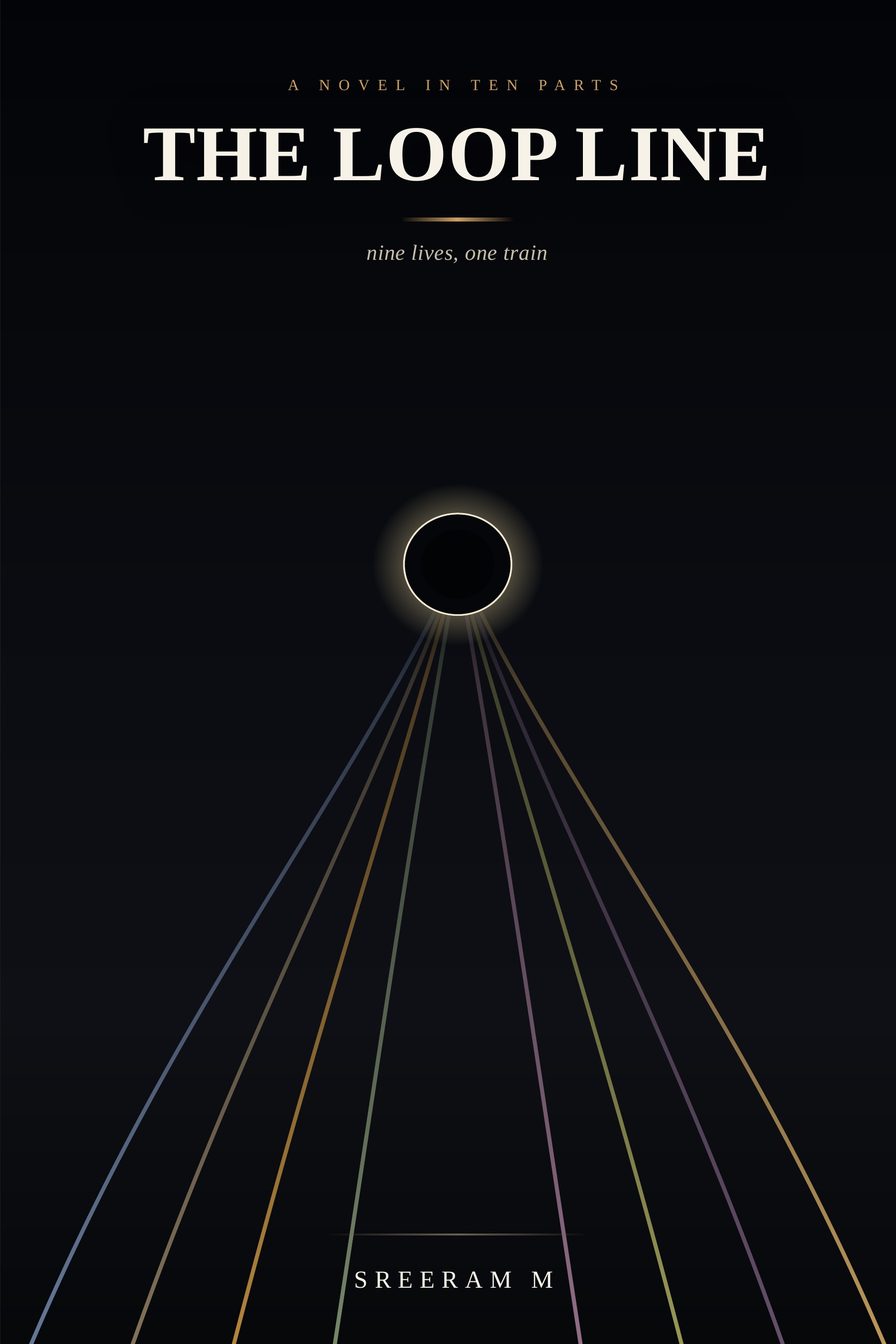
The Loop Line follows nine strangers whose lives share the same stretch of track: a daughter returning to a house that's smaller than she remembered, a girl losing seconds to a day that hasn't happened yet, a driver logging his last shift before the route goes automatic, and others whose smallest choices ripple through years they'll never see — until, in the tenth part, their paths finally converge.
Some journeys end. Some just fold back on themselves, again and again, until someone — the reader included — stops waiting for the arrival and starts paying attention to the ride.
No signup. Just read.
The first two chapters.
Part One — The Tunnel and the Well
Chapter One — Small Mercies
The conductor took my ticket without looking at my face, which told me she recognized me. I have made this trip twice a year for eleven years now, evens and odds, and by now the crew changes more often than the ritual does: check the ticket, glance at the berth number, hand it back folded, as though folding a ticket were a service they were still being paid to provide.
Compartment four. Lower berth, because I stopped requesting the upper around year three — three in the morning is kinder that way. Small mercies. I have learned to give myself a great many of these.
There's a person at the other end of this line I stopped trying to explain long ago, even to myself, and I don't say his name on the train — it stopped being deliberate and became a habit. He's about four days off; back and forth comes to eight, and I've always bought the return half without needing to think about it, proof, purchased in advance, that I intend to leave again. If you asked me what's wrong between us I'd have to invent an answer. The true one is like a room in a house lived in long enough: never entered consciously.
She had already finished her round and gone by the time any of this crossed my mind — checking names against a list she didn't need to check, the way she always does. Once she's done, she won't be back until the next stop, which on this stretch of the line is most of a day away. For those hours the corridor belongs to whoever's already in it. Nobody comes. Nobody leaves. It's the closest thing this train has to privacy, and I've never once used it for anything more than staring at country that doesn't change quickly enough to reward the attention.
Across the aisle, the woman with the cards was already three moves into a game she wasn't going to finish. I'd never learned her name in eleven years of overlapping departures — you don't, on a route like this, unless something forces the issue — but I knew the shape of her ritual by year four: the same worn deck, the same losing hand, abandoned always at the same card, as if finishing it would settle something she'd rather keep unsettled. Two berths down, a young man in a uniform too new for him was working a cloth over one boot with the concentration of someone defusing something. Somewhere behind me, cards of a different kind were already being shuffled for money, and the dealer's voice had the particular cheerfulness of a man who has never once, in his life, minded losing other people's certainty for them.
None of them were strangers to me in the way passengers are usually strangers. I'd simply never had a reason to call them anything.
I found the book where I'd left it, in the outer pocket of the bag I hadn't fully unpacked in three years. The standing theory is that a bag you never fully unpack is a placeholder for a story that never wants to be told. It was a novel about a man who climbs down into a dry well, looking for something he can't name. I don't know why I kept bringing it. Some books you don't finish because you're saving them, and some you don't because some part of you has already guessed how they end.
The samovar attendant came through not long after — I want to say his name was Grigori, though I couldn't tell you whether anyone had ever actually told me that — carrying a tray with a chip in one corner that has, as far as I can recall, always been there. By the time he reached compartment four, the tea was already going cold, which struck me as unusual, and then it struck me as familiar, in that order. He didn't ask if I wanted any. He'd learned the answer eleven years ago and saw no reason to keep confirming it.
I meant to read one chapter. I want that on the record, for whatever it's worth to record things that only I will ever check.
Chapter Two — A Fact About Trains
I read exactly as far as the man's hand touching the first rung, which is either page eleven or page forty depending on which of my two failed attempts you're counting, and then the book was still open on my chest and I was already climbing.
The well was narrower than I'd pictured it, which surprised me less than it probably should have. Ivy at the mouth, black and orderly, kept out of everyone's way like something with better manners than the house it belonged to. Not that there was a house. Someone would have removed it at some point, or there had never been one, only the well, standing on its own like a monument to a reason nobody had bothered to record.
There was a rope. There is always a rope, in these situations, or so I assumed on the way down — I had no evidence, only precedent, and by the second body-length of stone I'd stopped needing more than that. My hands found the holds the way hands find holds when they've already been told, somewhere, exactly where to look. The air got colder in the correct order — first cool, then cold, then the specific cold of somewhere no sun has ever properly arrived — and I remember being pleased about that, the way I'm pleased when the tea does what tea is supposed to do. Consistency, even underground, is not nothing.
At the bottom there was no water, which I had expected, and no bottom either, in the sense of a floor you could stand on and call finished, which I hadn't. Only more going down, unmarked, unlit, entirely reasonable.
I don't remember deciding to stop climbing. I remember light instead, arriving the way light arrives when you weren't asking for it — already there before you'd agreed to need it — and underneath it a long single note I recognized before I understood why: not thunder, not water. Wheels. The mouth of the thing I'd been climbing down into was exactly the mouth of the thing I was climbing out of, which is not a sentence I'd have signed off on in advance, and which felt, at the moment it happened, like the least surprising fact I'd learned all day.
The train came out of the tunnel. I came out of the well. I opened my eyes already knowing which of those had actually occurred, the way you know your own name without checking, and the book had slid from my chest to the floor of the compartment, spine up, exactly where the ordinary mechanics of an ordinary sleeping man would have put it.
The conductor took my ticket without looking at my face, which told me she recognized me.
I noticed it that time. Not the not-looking — I'd noticed that for eleven years — but the sentence arriving in my head a half-beat before she produced it, the way you sometimes finish a stranger's sentence and call it a coincidence because the alternative takes longer to sit with.
· · ·
Before launch
Read it before October 19th.
Get an advance reader copy
In exchange for an honest review on Amazon or Goodreads around release day, I'll send you a free advance copy of the ebook — first come, first served, while the 20 spots last. Copies are sent through StoryOrigin, which handles delivery and reminders for you.
Get my advance copy →Not looking for a review copy? Leave your email and I'll just let you know when the book goes live everywhere.
Questions
Good to know
What is The Loop Line about?
A literary novel in ten parts about nine lives that share the same stretch of rail line — among them, a man and the person at the other end of it he stopped trying to explain years ago, a daughter returning to a house she barely recognizes, and a girl losing pieces of a day that hasn't happened yet. It's a book about repetition, memory, and the journeys we take again and again while waiting for the one that finally changes.
When does it release?
October 19, 2026. The ebook is available now for pre-order on Amazon, Barnes & Noble, and Google Play, with Apple Books and Kobo following soon through a universal link. The paperback is already up for pre-order on Barnes & Noble.
Is it part of a series?
No — it's a standalone novel told in ten parts, each following a different character whose life intersects the same line.
Can I get an early copy?
Yes. A limited run of 20 free advance reader copies is available before launch, in exchange for an honest review on Amazon or Goodreads around release day. Request one above — copies are sent through StoryOrigin, which handles delivery and review reminders directly.
Where can I buy it?
Directly on Amazon (ebook), Barnes & Noble (ebook and paperback), or Google Play (ebook), or through this universal link, which will automatically add Apple Books, Kobo, and more as each becomes available — no need to check back for a new link each time.
It's also on Goodreads, with more retailer links appearing there as they go live.